Rethinking the “Mainstream College Student”
By Asha-Lee Peterkin
Living on campus, decorating dorm rooms, joining a club, lunch in the cafe, and experiencing college as a time of exploration and growth are all images that come to mind when we think about the “mainstream college student.” Our collective perspective is shaped by pop culture – the movies, the experiences we’ve had and the stories we’ve come to know so well – but that image is incomplete.
Higher education has always been made up of many realities at once. Students arrive with different responsibilities, timelines, and reasons for being there. Some are navigating college as a space for self-discovery. Others are balancing work, caregiving, or family obligations alongside coursework. The problem isn’t with the experience that exists — it’s that only one experience has been centered.
Parenting college students are not only weighing academic interests and personal goals, but questions of care, stability, and long-term planning: Does this school offer childcare? Can I manage my class schedule alongside work? Will my professors understand if life intervenes?
These layers don’t make student parents an exception to the college experience, they make them part of its fuller truth.
Schedules shaped by work and caregiving often mean choosing online classes, asynchronous learning, or quieter pathways through college life. Not because shared experience doesn’t matter, but because making it to graduation day demands holding together the delicate balance of school, work, and family.
For Tyrone Searles III, a student father and Generation Hope Scholar, that relationship to time plays out through an online degree program, studying cyber operations at University of Maryland Global Campus.
“I’m doing strictly online classes because I have two jobs,” he shared. “I don’t really have time to be on campus.” Online learning gives him the flexibility to keep his life moving forward. “It gives me the freedom to still shake and move in life how I want to.”
At the same time, the trade-off is real. “The caveat,” Tyrone said, “is you don’t really get to interact with any of the other students much… it seems a little singular — almost like homeschooling.”
For many student parents, this is where community is assumed to be absent.
But through Generation Hope, Tyrone has a different kind of campus community, one built around shared realities rather than shared schedules. In spaces where other student parents gather, he’s able to see his experience reflected back to him: parents balancing coursework and caregiving, students navigating life alongside ambition, people who understand that education doesn’t happen in a vacuum.
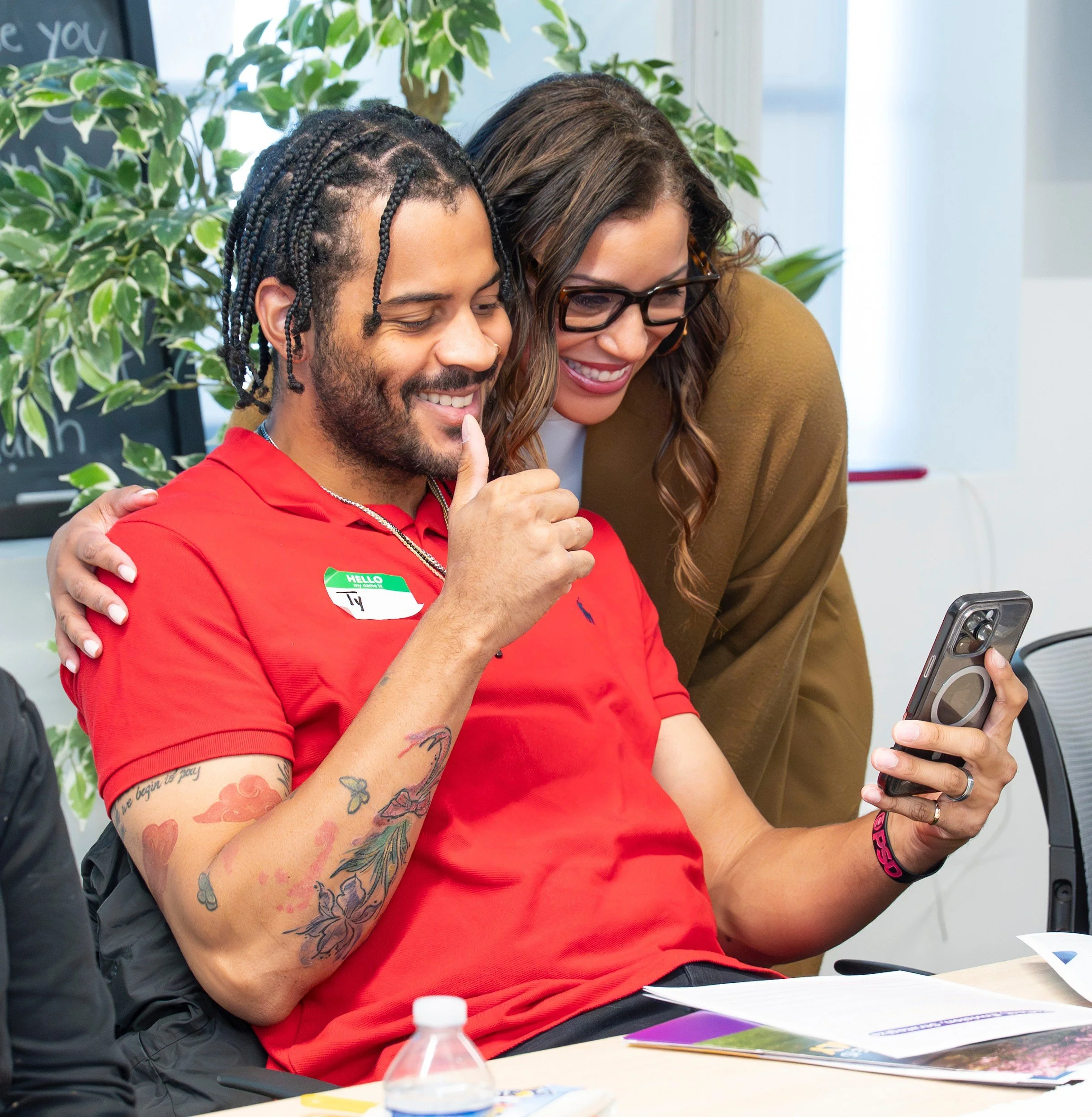
Tyrone and Nicole Lynn Lewis, Founder and CEO of Generation Hope, taking a selfie at Career Day for the DC Scholar Program
That sense of belonging matters. “Generation Hope makes me feel like I’m not disqualified from life,” Tyrone shared. In a culture that often treats young parents as if their path has narrowed or closed, being part of a community that affirms their presence can be transformative. “There’s this stigma where if you’re a young parent, it’s kind of just it for you,” he said.
In that way, Generation Hope becomes more than a support system — it becomes connective tissue. It fills the gaps left by traditional campus life and offers student parents a place to be seen, heard, and understood, even when their classrooms are online.
For Tyrone, continuing his education isn’t just about career goals. It’s about becoming the kind of parent he wants to be. “Going to school makes me a lot more confident in my parenting,” he shared. “Because it gives me something to feel like I’m looking forward to — not only to provide a better opportunity for myself, but my children as well.”
Tyrone’s experience is not an exception but rather a reflection of how higher education already looks for so many students whose lives don’t fit a single narrative.
But inherited ideas aren’t fixed ones. They can be examined, expanded, and reimagined. At Generation Hope, this reimagining isn’t theoretical. It’s the work we return to every day.
As we look ahead to 2026 and beyond, we are continually asking ourselves what it means to truly reflect the world student parents are already living in, not the one higher education was once designed around. We are listening more closely. We are naming what has too often gone unseen.
That work doesn’t belong to institutions alone. It belongs to all of us who shape culture, policy, classrooms, and conversations.
It asks us to make room for the full reality of students whose ambition is inseparable from care, whose education is inseparable from responsibility, and whose presence reshapes the communities they are a part of.
Student parents are writing higher education’s story; thoughtfully, deliberately, and in real time.
And as that story continues to unfold, the question isn’t whether higher education will change. It's whether it will choose to recognize the students who already define it.
Download EmPowerED Dads to better understand the experiences of student fathers like Tyrone.