Jeannette’s Steady Hands
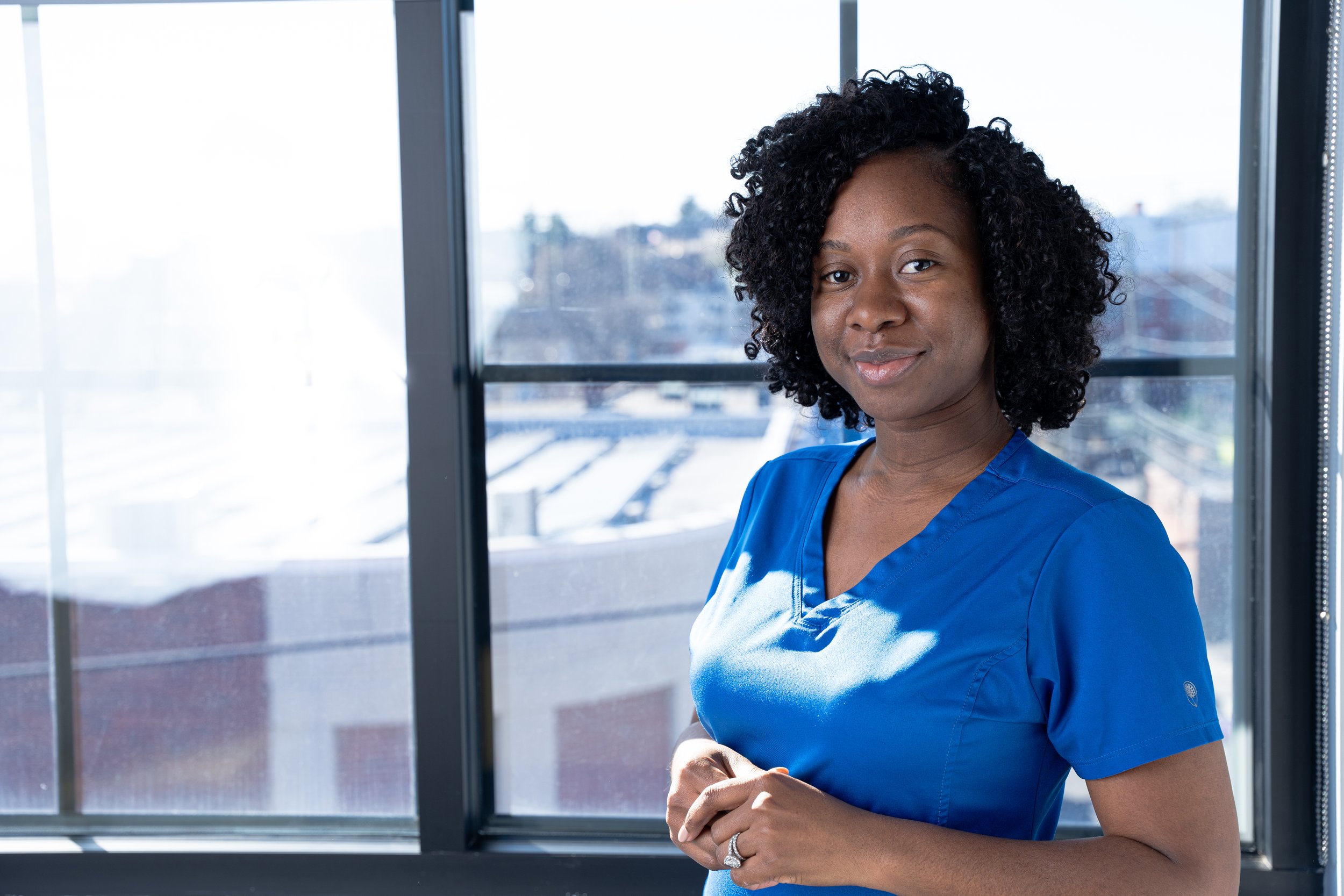
Jeannette Dore is a Generation Hope Scholar Alumna who built a career in nursing through skill, determination, and access to the right support at the right moment. She walks and speaks with an unmistakable confidence. She stepped into our national office on a blustery January day to share her truth with warmth, and without reservations. But she wasn’t always this self assured.
Today, she works as a home infusion nurse—trusted with patients’ lives, medications, and care coordination in their most vulnerable moments. Her work requires precision, discipline, and judgment. It is frontline healthcare, carried out largely behind the scenes, in homes across the D.C. region.
That professional acuity did not come easily.
Jeannette learned early what it meant to show up for someone who was depending on her—long before she was responsible for coordinating care plans or administering complex treatments. At nineteen, she became a mother while navigating homelessness.
“I was 19 years old when I became a parent. My life was not easy at that time. I was homeless from about age 15 to 20. When I had my daughter, I was still homeless. With the help of resources that I had around me, I was able to make it.”
Those years divided life into measures of survival. Days were shaped by constantly evaluating where they could sleep, whether she could eat, and how she would keep her daughter safe at all costs. College, in those moments, was not a dream deferred. It was a dream placed out of reach—not because Jeannette lacked the desire to attend, but because the systems surrounding her deemed her as unworthy.
Regardless, becoming a nurse always called to her.
Nursing represented stability for her family and a way forward that felt aligned with who she was and what she had witnessed growing up.
“I was drawn to nursing because I always had a passion for working in the medical field. Growing up, I saw a lot of people suffering. I told myself that one day I wanted to help people and save lives, and that became my reality.”
Jeannette arrived at her career goal because she understood what it meant for her career path to be needed—and because she was willing to persist through an education system that was narrow and unforgiving for her as a parent.
Her journey back to higher education was neither linear nor guaranteed. She first heard about Generation Hope through a coworker. At the time, she was not fully convinced that college was possible.
“I first heard about Generation Hope through a friend I worked with at Target. I applied for their scholarship even though I was not thinking seriously about going back to school at the time.”
During her first interview, she was asked a question that would force a decision:
“After my first interview, I was asked if I had a university I planned to attend, and I did not. I was told I could not keep the scholarship without that plan.”
Jeannette went home and kept thinking about it. The team reached out with some friendly reminder emails. Weeks passed.
“I went home and thought about it. Weeks later, I reapplied with a school in mind, even though I was not sure how I would pay for it. That is how my journey with Generation Hope began.”
What followed was not just financial assistance, but a true community.
“Generation Hope provided clothing resources, food support, counseling, and emotional support. The counseling was especially important because I was dealing with depression. Generation Hope felt like a family to me.”
That level of support mattered because nursing school demanded everything at once. Clinical hours were inflexible. Exams did not pause for childcare emergencies or school snow days. And the costs were staggering.
“Nursing school was very expensive. Some textbooks cost over $1,000, and renting books could cost $300.”
Federal student loans secured the needed funds that her immense grit alone could not.
“Federal student loans helped fill the gaps. Without federal grants and loans, there is no way I could have gone to school. My tuition was about $32,000 per year. Without that support, I would have spent my entire nursing career repaying loans.”
Without that access, the math would not have worked. Not for Jeannette. Not for her daughter. Not for their daily realities.
Today, Jeannette is a professional whose days are precise, disciplined, and demanding. She schedules patients, manages treatments, coordinates with physicians, and ensures continuity of care. Her patient’s lives are in her steady hands. Amid the economic downturn, her skills are still in high demand.
And yet, policies now being proposed could have halted her progress.
Under the Trump administration’s One Big Beautiful Bill Act, signed in July 2025, the U.S. Department of Education is implementing changes that redefine which graduate fields count as “professional” degrees. These changes exclude nursing (and a wide range of other degree types) from that category, eliminate the Grad PLUS loan program, and cap federal borrowing for graduate students at $20,500 per year and $100,000 total for “non-professional” programs, with a lower cap than previously available for nursing and related fields, all scheduled to take effect by July 1, 2026 — changes that advocates warn will make it significantly harder for nursing students to afford their education.
Jeannette is clear about what these changes would have meant: “This policy would have prevented financial stability. It would have made it impossible to attend school, eventually own a home, or provide better for my family. Many people would give up their dreams and remain stuck where they are.”
"Reclassifying graduate nursing degrees and other advanced programs in ways that restrict access to federal student loans is not a neutral bureaucratic adjustment. It is a moral decision—one that quietly declares which students are worth investing in and which families are expected to absorb the cost of systemic neglect. These changes all land hardest on student parents, who are disproportionately women and disproportionately people of color. They are already balancing caregiving, employment, and education with less margin for error, and the reclassification makes it more difficult for them to advance in their careers."
If federal loans had been capped for Jeannette's nursing program, she would not have been able to graduate. It would have meant remaining in low-wage work, taking on double shifts, seeing her daughter less, earning less, and saving little. It would have meant sacrificing long-term stability for short-term survival — the tradeoff our systems routinely demand of families pushed to the margins.
This contradiction sits at the center of the reclassification debate. Policymakers call nursing a high-demand profession while erecting new barriers to entry, warn of workforce shortages while closing off pathways to the field, and depend on nurses in moments of vulnerability while questioning whether aspiring nurses—especially parents—deserve access to affordable education.
Jeannette’s story exposes the flaw in the premise that reclassifying nursing degrees and limiting federal student aid will improve higher education outcomes — because the real impact will be to cut off access to vital financial resources for students pursuing essential high-skill careers like specialized nursing.
More than a degree, and more than a career.
Jeannette’s degree did not just change her life. It changed her daughter’s expectations of what is possible. It shifted a family’s trajectory from uncertainty to stability. It transformed public investment into public good. This is economic mobility—not theoretical, not aspirational, just real.
“My daughter saw me struggle and persevere. Education is important to her because she learned it from me. She is doing very well in school.”
Generation Hope exists as a crucial changemaker at this intersection: where individual determination meets structural constraint, and where policy decides whether effort is rewarded or erased. Jeannette’s story reflects the realities of hundreds of thousands of student parents pursuing high-demand professions that keep our communities and economy functioning.
Allowing nursing degree reclassification to proceed unchecked does more than alter funding structures; it excludes families like Jeannette's who are essential to our workforce from opportunities that create long-term stability.
And the cost of that decision could someday be borne not just by student parents, but by all of us, who depend on a healthcare system sustained by people who were once told their dreams were too expensive to support.